
CRITICAL REFLECTIONS
"I am not in one place, just in between."
This quote by Do Ho Suh deeply shaped my perspective in the development of my work for this Unit. I didn’t quite realise when Unit 2 began; it felt like a short, spontaneous phase, yet one filled with immense learning.
My continuation from Unit 1 naturally flowed from my growing interest in video projections. I wanted to explore moving image and video independently before turning to the practices of other artists. While Nalini Malani’s work at the Whitechapel Gallery intrigued me, I felt compelled to focus more intimately on my own homeland and to understand how my current experience of finding myself in a new city contrasts with my past relationship to a place I once called home.
I remember writing in my sketchbook: “What is home? Why should it be here?” during the process of creating my artwork 'The Faint Touch' in which I aimed to portray two different lands through moving image and documentation. The video I created felt like a memory, a dreamlike and distant recollection of home.Working with video projections and moving image allowed me to realise the emotional depth that comes from experiencing these two mediums differently.


Details of works , 'A faint touch', Oil on canvas
Continuing my research into identity and the idea of home, the book 'Cosmopolitan Belongings: Location and Emotion' by Hannah Jones and Emma Jackson played an important role in shaping my analysis. It challenged traditional ideas of identity and community by focusing on everyday life and ordinary encounters, suggesting that cosmopolitanism isn't just about grand ideals but is grounded in small, emotional, and sensory details of living with difference.I soon began to notice how my own work was being profoundly shaped by these ordinary encounters, smells, conversations, and places.
The line from Saha and Watson, “Belonging is often marked by unease; people might love the community they live in while feeling displaced by its changes,” stayed with me. Saha also discusses ‘ambivalence,’ a tension between seeking familiarity and confronting difference. This speaks to the conflicting senses of home, migratory histories, and layered identities in urban settings.The case study on Walworth by Emma Jackson in the same book was particularly striking. It explored how migration, gentrification, and displacement manifest in everyday spaces, treating Walworth not as a fixed place but as a living site of layered identities, a place where people constantly negotiate their sense of belonging.
This resonated deeply with me, as Walworth, neighbouring Camberwell, is an area I often documented and explored in my own work. It was precisely this ambivalence of the place that I was connecting with.


Documentations of Camberwell and Walworth
Through this reading, I encountered the idea that sensory and emotional ties to personal objects, food, smells, and gestures can anchor feelings of home, often small, mundane, but deeply meaningful things. Anthropologist Daniel Miller refers to this as “the comfort of things.” This helped me understand why my own work had shifted from drawing people and places in broader contexts to creating more intimate compositions.Discussions with peers helped me in this. They commented that my recent works, especially in their titles and treatment, felt noticeably more personal. These works, created on new types of paper, were driven by intuition and inspired by recent lived experiences and observations. I found the smoothness of the paper particularly engaging and enjoyed the way it supported the subtleties of these more introspective compositions.


Details of works , 'The Missing Cat' and 'A wait', Oil on paper
Reading further, I found myself understanding why my sketchbooks often focused on daily objects or cozy corners in my room. I began to collect small objects, like flowers, which I would let dry and keep near the small altar in my room every evening as they brought me comfort.
I did not know what I wanted to do with them or what should do with the dried flowers, but that action of holding back on those dried flowers felt like a way of preserving the culture from back home.
“Things do not just make us feel at home; they allow us to construct and maintain our sense of self.” : Daniel Miller, The Comfort of Things

Dried flowers from alter
These everyday items became my emotional anchors, echoing Miller’s idea that material culture plays a central role in shaping identity and belonging.My work began to gravitate towards material-based processes and smaller formats. I started making my own pigments and experimenting with new media. The act of creating pigment felt significant as it added a strong layer of context to my work. I began using naturally sourced spices, especially from Goa, such as powdered Goan chillies, homegrown turmeric, and a blend of spices my grandmother had prepared for me.These were the same spices I used in cooking, the food which had become my only source of comfort during the long, dark winters. I wanted to explore how the smell and sensory memory of these spices could find a place in my visual practice.
Without realising why, I developed a strong fascination with the colour brown. I began documenting brown elements across London, and soon, this colour began to feature prominently in many of my works.

Laking and Calcinating process using chilly powder


Random brown documentations
While researching at the Warburg Library, I came across an interesting research paper: Being Home: Exploring the Idea of Home and Belonging through Art Practice by Blanca Rodriguez Beltran. The text resonated deeply with my experience of homesickness and my interest in material-based inquiry.
It explores the emotional conflict between being physically “at home” and emotionally displaced, a feeling familiar to many navigating life in a new city.Beltran’s work demonstrates how language, place, and memory come together to shape our perception of home. Her practice, alongside artists like Louise Bourgeois and Do Ho Suh; the artists that had inspired my process as well, suggests that home is not necessarily a point of origin but a fragile construct shaped by lived experience, grief, memory, and the body. This mirrors my own experiences of relocating to London, where repeated gestures and rituals often serve as the only anchors in a constantly shifting sense of self.
The concept of homesickness as explored in Beltran’s work was particularly fascinating. The way she uses embroidered text began to resonate with the text in my own sketchbooks and how I use line in my works, where I again found myself revisiting the use the line.
Architect Juhani Pallasmaa describes home as both a physical and existential space central to our identity, memory, and emotional well-being. My painting The Sound of Waves, an oil on canvas, emerged from this understanding. It depicts a church scene I encountered while exploring London. Revisiting that image immediately brought back memories from my childhood in Goa. I grew up in a secular neighbourhood, and as a child, I often accompanied my Catholic neighbours to church during Mass. The golden walls, the soaring ceilings, the warmth of candlelight in the dim ambience of an early morning service, all of this evoked a powerful sense of home. The image of people gathered around a candle stand on a cold winter evening in London brought that same warmth back to me.

Details of works , 'The sound of waves', Oil on canvas
During the Transmission Residency, my works shifted further towards small-scale formats, especially paper. As discussions of transportation and display for the Toronto and London exhibitions emerged, I grew more drawn to the materiality of oil paint on handmade paper. I loved the way the paint moved freely across the surface. This led to a new series focusing on London’s transport system; the London Tube, through which I explored themes of urbanisation, isolation, and the paradox of crowded spaces filled with solitude.
The Transmission Residency became a really important part of how my work developed during Unit 2. It ran from December 2024 to May 2025, and connected me with students from both City & Guilds of London Art School and the Ontario College of Art and Design (OCAD) in Toronto.I was part of a group that focused on exploring different types of transport systems, and this collaboration opened up new ways of thinking for me. It was during this residency that I started to experiment with sound in my projections for the first time. I began using audio recordings from Indian transport systems, rivers, and London’s public transport, trying to understand and connect to how sound could shape the atmosphere of my work. The experience of working with people from different backgrounds and cities made me more aware of how movement, sound, and place are all connected.


work in progress for exhibition display

work in progress of 'The next station', Oil on canvas

Details of work series , 'There will be no miracles here', Oil on paper
when I returned to my hometown in Goa, I realised how deeply I wanted to incorporate an element of home into my work. I had already developed a strong interest in working with pigments, and with my ongoing fascination for the colour brown, I began researching Kaavi art, an ancient Goan art form that is now nearing extinction. Traditionally, Kaavi art was created using red laterite soil, mixed with jaggery and lime putty to form a paste. This paste was applied to walls, and designs were etched into it to reveal intricate motifs.
I began exploring different types of soil from across the region and came across artist Sagar Naik Mule, who specialises in and actively promotes Kaavi art. Interviewing him deepened my interest in the textures and gradients of soil from different places, and how each type could yield unique pigments. What amazed me even more was Sagar’s perspective, he connects soil to spirituality, believing that the rituals and gods of the land shape the soil’s colour and texture.
Though I don’t consider myself particularly spiritual, I felt that this was Sagar's way of finding comfort in his works and began to wonder on where my own sense of comfort and connection lies within my practice. Is it in the line? In the act of documentation? These questions lingered as I continued my search for the perfect red soil traditionally used in Kaavi art. Eventually, I found a close match in the Ponda, a region of Goa, which I ground into a fine powder.

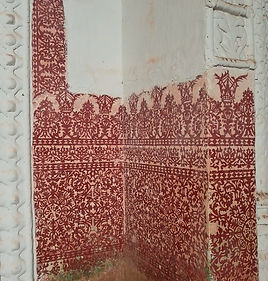
Kaavi Art on Church intrados, Old Goa
image courtesy: buildgrounded.com
Kaavi Art on Church interiors, Old Goa
image courtesy: buildgrounded.com

Kaavi Art on Church interiors, Old Goa
image courtesy: buildgrounded.com


Kaavi art restoration at Vargao Temple, Bicholim
Self Documented
Small recording clip of conversations with Sagar :
Language: Konkani, Western Coastal India
Translated transcript:
Me: So, I want to know more about these pigments which you use and why did you specifically choose this soil?
Sagar: So, this pigment which you ask me about, I have different types of methods of working with this pigments. I am going to experiment with them in my later works. Currently, as you can see, I create these textures in my works using course soil.
Let me tell you something, this soil which I have found, it showed me the universe. The more deeper I went, I could see the universe and the gods in it.It happens when I talk with the soil I am working with, after which all ideas come easily to me. A single day is very less to explain about what soil means to me. But I am very confident with the time I need to work with this soil on my works. I don’t need to think much, my hand automatically starts moving and ideas automatically emerge.So, that why I say that Soil showed me the universe. It feels like god is taking care of me.That is the power of soil.
And I am a person who has grown up in poverty, I have known that when no one is there for me, the soil is there. That’s why I take the soil everywhere now.It gives me a feeling that I am working for my land, my country.
Therefore wherever I go, I carry the soil with me, and I feel that Goa’s soil has reached everywhere.This makes even people feel more attached to me and I feel nice, because I never work as an artist, I always call my self as a worshipper of the soil.
Me: But different types of lands will yield different colours of soil right?
Sagar: Yes, actually in Goa, there are numerous varieties of soil; all have a different flavour to them.
Kaavi Art Process:
Kaavi art involves grinding red laterite stone into a fine powder, which is then mixed with jaggery (derived from sugarcane) and shell powder or lime putty to form a thick paste. This mixture is applied to a chalk- and gypsum-based wall, and once dried, the motifs are etched into the surface, blending them in a form sculptural carvings.

Artist Sagar Naik Mule with Urvi Keny


soil grinding
Grinded stone for pigment making
Red laterite stone
Soil searching for red stone pigments across Goa.
Location: Ponda, Goa
I am still in the process of exploring and working with these pigments, it's a work in progress. I also hope to experiment with creating artwork using the traditional Kaavi art method. My exploration of the colour brown continues to evolve.
As Unit 3 approaches, I find myself returning to video projections, particularly projection mapping, which I’ve been learning from specialist technicians Mariana Fantish and Nicholas Healy at the Studio for Contemporary Arts, Chelsea College of Art. I intend to incorporate this medium into my summer show display. I also hope to work with soil pigments and create a wall-like structure for the installation, combining mixed media in a way that bridges past and present, place and displacement.
Detail of video projection from series 'There will be no miracles here', 2025
Citations:
-
Suh, D.H. (2020) Artist Interview: Do Ho Suh. Interviewed by V. Li for Dallas Museum of Art Uncrated, 13 August. Available at: https://blog.dma.org/2020/08/13/artist-interview-do-ho-suh/ (Accessed: February 2025).
-
Saha, A., 2015. ‘Locating Emotional Belonging’ in Jackson, E. and Jones, H., eds. Stories of Cosmopolitan Belonging: Emotion and Location. Abingdon: Routledge, pp. 39–52.
-
Bachelard, G. (2014) The Poetics of Space. Translated by M. Jolas. New York: Penguin Books.
-
Rhys-Taylor, A., 2014. Intersemiotic fruit: mangoes and multiculture. Emma. Jackson and H. Jones, eds. Stories of Cosmopolitan Belonging: Emotion and Location. London: Routledge, pp.44–54.
-
Hall, S., 2015. Migrant Margins: The Urban Life of Street Corners. Emma. Jackson and H. Jones, eds. Stories of Cosmopolitan Belonging: Emotion and Location. Abingdon: Routledge, pp. 18–38.
-
Miller, D., 2008. The Comfort of Things, p.13. Cambridge: Polity Press.
-
Jones, H. and Jackson, E., eds., 2015. Stories of Cosmopolitan Belonging: Emotion and Location. Abingdon: Routledge
-
Pallasmaa, J. (1996) ‘The Geometry of Feeling: A Look at the Phenomenology of Architecture’, in Nesbitt, K. (ed.) Theorizing a New Agenda for Architecture: An Anthology of Architectural Theory 1965–1995. New York: Princeton Architectural Press, pp. 448–453.
-
Rodriguez Beltran, B. (2023) Being Home: Exploring the Idea of Home and Belonging through Art Practice. PhD thesis. Oxford Brookes University.
-
Racz, I. (2015) Art and the Home: Comfort, Alienation and the Everyday. London: I.B. Tauris.
-
Schön, D.A. (1983) The Reflective Practitioner: How Professionals Think in Action. New York: Basic Books.
-
Naik Mule, S. (2025) Interview recording [in Konkani]. Recorded by Urvi Keny in conversation. Personal collection. 3 April 2025.
-
Grounded (2024) ‘Kaavi, Goa’s Forgotten Art Form’, This Is Epic, 5 December. Available at: http://www.buildgrounded.com/houses-in-goa-blog/2024/12/5/kaavi-goas-forgotten-art-form (Accessed: April,2025)
-
Soil Science Society of America (2015) Soils, Culture, and People. Available at: http://www.soils.org/files/sssa/iys/december-soils-overview.pdf (Accessed: April,2025).